Introduction
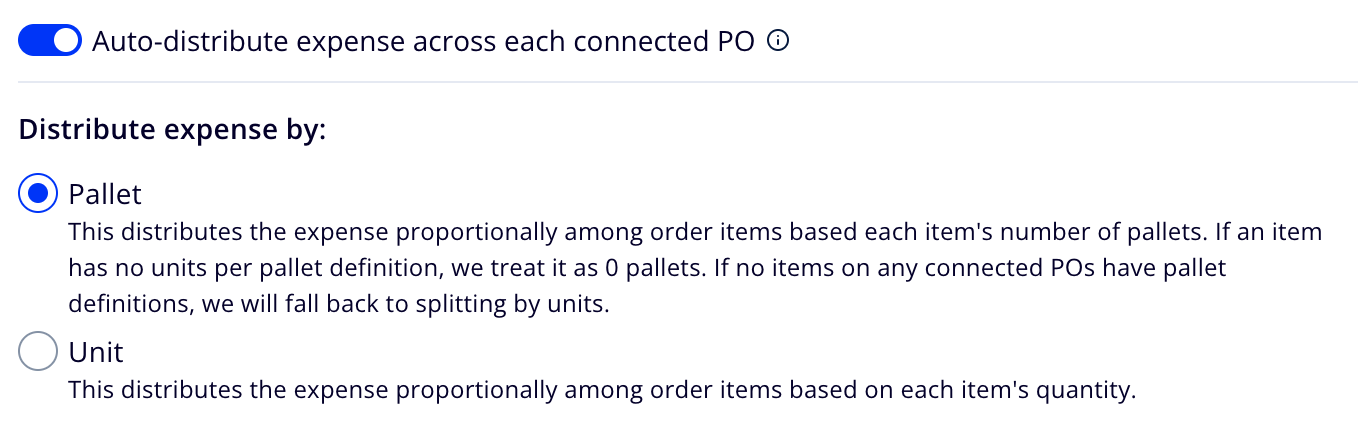
You can choose to proportionally distribute PO expenses across all connected POs either by unit or by pallet. The purpose of this guide is to explain how each expense distribution method works so you can choose the one that best fits your needs.
Distributing by Unit
Each unit gets an equal share of a given expense, so the expense amount per unit will be different for each item depending on the number of pallets on the order.
The example below shows a freight expense of $250 connected to a single order. Since there is a total of 200 units on the order, each unit will get $1.25/unit expense ($250 / 200 units)

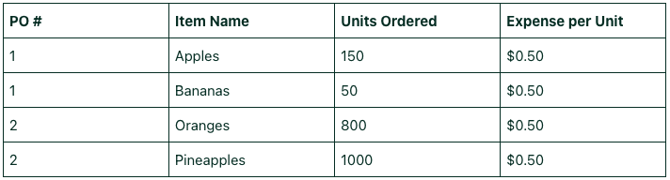
Distribution works the same when there is more than one PO connected to an expense – each unit on each connected order gets an equal share.
In the example below, there is a $1,000 freight expense connected to two orders. Since there is a total of 2,000 units across the two orders, each item will get $0.50/unit, regardless of what PO it is on.
Distributing by Pallet
Each pallet gets an equal share of a given expense. If an item does not have a pallet definition, it is treated as 0 pallets and does not receive any share of the expense. If an item has a partial pallet (e.g., if you order 50 units of an item with a definition of 100 units per pallet), it will receive a partial share of the expense.
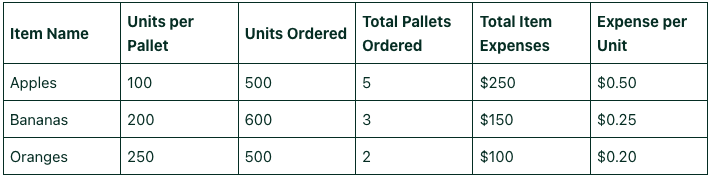
Even pallet distribution example
Total freight expense of $500. Since there is a total of 10 pallets on the order, each item will get $50 ($500 / 10 pallets) worth of expenses.
Missing pallet definition example
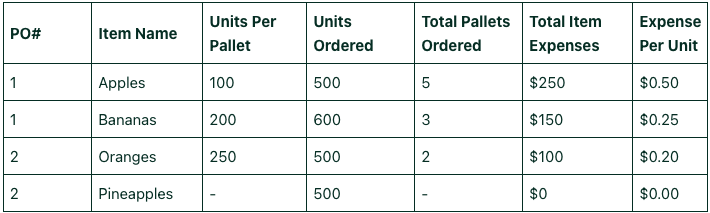
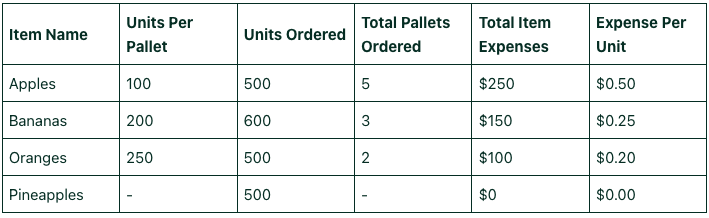
In the example below, one item is missing a pallet definition, which we will treat as 0 pallets; therefore, it does not get any expense distribution. The total expense is still $500, as in the example above.
Partial pallet example
The total expense is $500, but each item has a partial pallet. Since the total pallet count is still 10, each pallet gets $50 worth of expenses, and the distribution still ends up being the same.

Multiple connected POs example
In the example below, the expense is connected to two POs. Similar to units, we distribute the expense evenly across all pallets on all connected orders. Since there are 10 pallets total across the two orders, each pallet still gets $50 worth of expenses.