Statements in Silo can be printed to give to your customers or emailed or faxed directly to customer contacts. This article breaks down what what configuration options are available for statements.
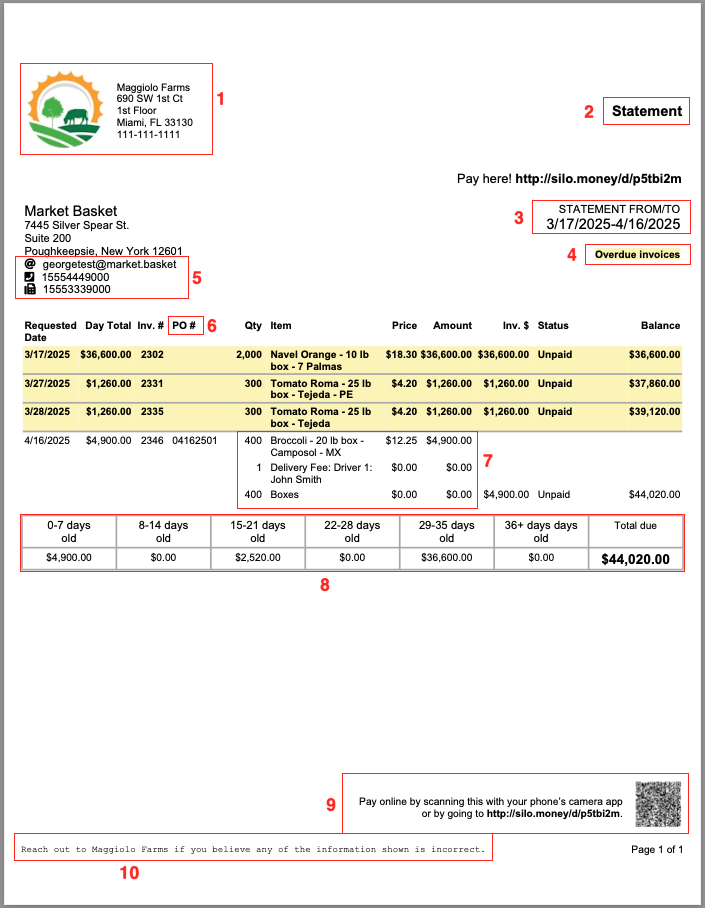
- The top left corner of the statement displays the company logo, company name, billing address, and company phone number for your Silo account. If you don't have a specific billing address, your shipping address will be used instead. These are configured during implementation, but if you need to update them you can reach out to Silo Support.
- The label at the top of the statement can be configured to either say "Statement" or "Invoices". This is controlled by the Statement label setting in Finance > Sales > Statements > Statement settings.
- Statements can be configured to either show outstanding invoices within a given date range (From / To) or all outstanding invoices up to a specified date (As Of). You can configure Default statement dates from Finance > Sales > Statements > Statement settings, but you can also override or adjust the dates from the filters section of the Statements screen.
- You can configure whether or not overdue invoices are highlighted in yellow using the Overdue invoice display setting in Finance > Sales > Statements > Statement settings.
- The contact information for each customer contact configured to receive statements will appear at the top of the document. If there are multiple statement contacts, multiple copies of the statement will be included in the pdf (as well as a blank cover sheet). If you'd prefer to only print/email a single copy of the statement even when there are multiple statement contacts, you can turn on the Statement copies setting in Finance > Sales > Statements > Statement settings.
- You can control whether the customer PO number for each invoice displays on the statement with the Statement columns setting in Finance > Sales > Statements > Statement settings. If customer PO numbers are shown, you can also choose whether invoices on the same date should be sorted by customer PO number.
- Detailed statements will display every item from each outstanding invoice; simple statements will display a single line with the invoice total. You can control the Default type of statement from Finance > Sales > Statements > Statement settings, but you can also override from the filters section of the Statements screen.
- The customer's aging information is displayed at the bottom of the statement. You can configure whether to show debt aging or unpaid sales aging using the Preferred aging type setting in Finance > Sales > Statements > Statement settings.
- If you are using Silo Collections, you'll have the option to show a QR code and link to allow customers to send you a digital payment for their invoice. Whether these appear on invoices by default can be configured in Finance > Silo Pay by pressing Edit next to the How you're receiving payments heading. They can also be turned off for a specific customer from the Contacts > Customers screen by editing the desired customer and toggling the Hide digital payment link from this customer's statements and invoices checkbox.
- You can configure a disclaimer to display at the bottom of all statements using the Statement disclaimer setting in Finance > Sales > Statements > Statement settings.
Other Important Settings
- The Exclude unapplied credits and overpayments setting in Finance > Sales > Statements > Statement settings controls whether unapplied credits are counted towards a customer's overall statement balance. If you are not seeing a customer listed on the Statements screen even though they have unpaid invoices, it may be because this setting is turned off and the customer has more unapplied credits than their total unpaid invoices.
- The Ignore payment dates when calculating statement balance setting in Finance > Sales > Statements > Statement settings controls whether payments that occurred after the end date of the statement are reflected in the balances shown. If an invoice that has been paid is appearing as unpaid in a statement, it may be because this setting is turned off and the payment occurred after the statement's end date.